Monday, 3 November 2025 08:12:00 Author Andrii Chernitskiy
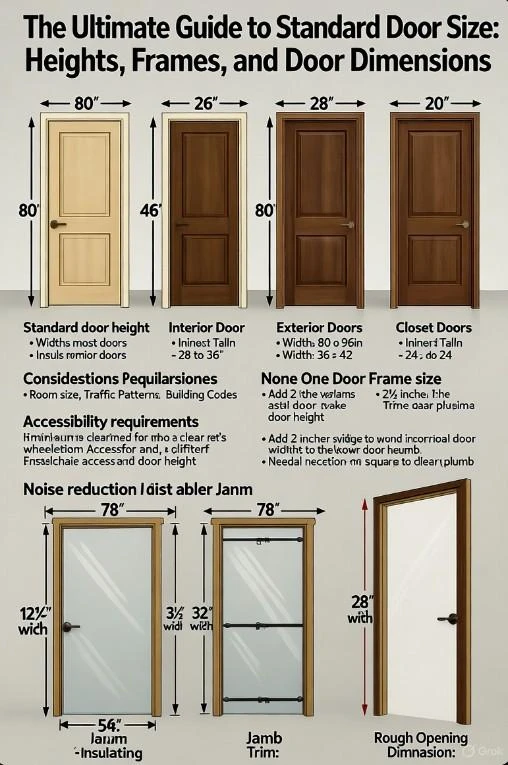
For most American homes, the standard door height is 80 inches (6 feet 8 inches), while standard door widths range from 28 to 36 inches based on the door type and its location. The door size for exterior doors is 80 inches high and 36 inches wide. Most interior doors have a height of 80 inches with widths of 30, 32, and 36 inches. Closet and utility doors are smaller, at approximately 80 inches high and 24, 30, 36, 48, 60, or 72 inches wide.
The one thing to keep in mind before placing any orders is that these numbers describe the door slab, not the opening in the wall. A door of 80 inches requires an opening that is taller than 80 inches when you take into consideration the jamb, shims, and clearance required for installation. The existing opening might look close to the right dimensions but still not accept the door you have chosen. Check the actual opening and the manufacturer's installation requirements before buying a slab or pre-hung door.
The door itself is also only part of the picture. An interior hinged door, a closet system, and an exterior entry unit can have quite different dimensions even in the same house. The standard door size figures in the table below provide a starting reference for the most common residential applications.
| Door Type | Standard Height | Standard Width | Standard Thickness |
|---|---|---|---|
| Standard interior door | 80" | 30", 32", or 36" | 1 3/8" |
| Standard exterior/entry door | 80" (96" also available) | 36" (typically 36"–42") | 1 3/4" |
| Standard closet door (bifold) | 80" | Bifold: 24", 30", 36", 48", 60", or 72" | Typically 1 3/8" |
| Standard bathroom door | 80" | 24"–28" | 1 3/8" |
| Standard patio/sliding door | 80" | 60", 72", 96", or 144" | Varies by system |
| Standard garage-entry door | 80" | 32"–36" | Typically 1 3/4" |
The figures above refer to the door units themselves, not necessarily to the framed opening they will go into. That difference is easy to overlook when replacing a door. A door slab is fitted into a jamb with its hinges and hardware installed separately, whereas a pre-hung door comes with the slab already mounted in its frame. So the measurements needed for the job depend partly on what is already in the house and what is being replaced.
The interior door dimensions can also vary with the type of door. A hinged bathroom or bedroom door is installed differently from a bifold closet door, where two or more panels fold back against each other. Bifold doors come in a range of standard widths, and sliding closet doors depend on the panels and track system being used. The dimensions listed by the manufacturer are therefore more useful than assuming that a product's nominal size is the same as the finished opening.
Entry and patio doors bring a few more variables into the picture. Exterior door dimensions generally involve a thicker door assembly designed to deal with weather exposure, while a patio slider is a wider system with multiple panels and a track. The existing frame, threshold, and available space for the door to operate can all affect what will fit. If you are comparing replacement options, you can shop entry doors and then check the installation dimensions against the opening you actually have.
These are just the basics and not a substitute for project-specific measurements. A door that is larger may need a new unit as well as added framing. Projects with specific code requirements will also need commercial and code-specific door sizing done prior to ordering the door.
When renovating or building a new home, having door measurements nailed down from the beginning can mean the difference between success and failure. A door even half an inch off can result in poor fit, air leaks, or even safety issues in the future. Having an understanding of standard door sizes used in American homes is imperative to ensuring that your installation will seamlessly coexist with your frame systems, hinges, and openings in walls.
Contractors like UBrothers Сonstruction typically emphasize how accurate measurements go hand in hand with accurate window sizes—because coordination between doors and windows is not only about aesthetics; it's about balance and energy efficiency throughout your home.
“Measure twice, cut once. The truest craftsmanship begins with precision.”
The standard door height in the United States is 80 inches (6 feet 8 inches), and the usual width can be anything from 28 to 36 inches, depending on the type of door and where it's located. These measurements may seem infinitesimal on paper, but have been built up over centuries of construction practice, accessibility guidelines, and manufacturing conventions.
For perspective, here's a quick summary of typical dimensions used on single-family homes:
Still, don't treat those numbers as fixed standards. Door sizes can shift a bit depending on the brand or where you live. Always double-check the actual door measurements before you buy or start framing. Saves you a headache later.
You don't pick door dimensions at random — it's about what the room's meant to do. A bedroom door should give some privacy but still be easy to use. An entry door's job is tougher — it needs to handle weather, noise, and wear.
Here's what to think about when picking the right size:
Every inch matters. The right door size isn't just about looks — it affects how comfortable and practical the space feels.
When we talk about standard door frame size, it's not just the slab. You've also got the jamb, trim, and the rough opening that ties it all together. Getting that right from the start keeps the door straight, swinging smoothly, and sealing tight.
The frame ensures the door swings freely without rubbing or jamming. To calculate the correct fit, you'll need to account for tolerances in both width and height.
Here's how to estimate the ideal frame and interior door rough opening:
If your walls are anything other than perfectly straight (and they typically aren't), these tolerances prevent binding or crooked gaps when the door is installed. Precision in this instance is what causes a door to close tightly and latch securely for years.
Door frame height could easily be confused with the height of the door. Knowing how these dimensions differ will prevent any mix-ups in planning for the rough opening. Thus, even if the interior door height is 80 inches, the door frame opening shouldn't be 80 inches, since you need some allowance for the jamb and minor differences that may arise during installation. If the door is prehung, the door slab and frame come together, and the rough opening is the part of the wall into which the door assembly will be installed.
A simple formula to use here is:
Door slab height + frame and installation allowance = rough opening height
Take a standard 80-inch door. As noted above, a rough opening of about 82½ inches is a common planning figure, leaving roughly 2½ inches for the head jamb, shimming, and clearance at the floor. That extra space is what allows the door unit to be positioned and adjusted during installation.
The 82½-inch figure is useful when planning, but it is not a fixed size for every door. Rough opening height can change depending on the pre-hung unit, jamb construction, finished flooring, and the manufacturer's installation requirements. When those specifications give you a different measurement, use them rather than relying on the general 82½-inch guideline.
There is another distinction worth keeping in mind. The frame is the finished assembly around the door slab. The rough opening is the larger unfinished space in the wall before that assembly goes in. This matters most when an existing door is being replaced. An opening can be close to a familiar standard size and still need a different door unit or some framing work.
When a new construction project is under way, then the chosen pre-hung door would be the best place to start: the instructions included with the door will specify the size of opening that the builder must provide. When in doubt about which measurements to use, it may be helpful to schedule a consultation prior to ordering a door.
Having your standard door frame size right is only half the issue. The final fit must also meet door clearance requirements, which are the small gaps remaining between the door and the floor or frame. These gaps offer ventilation, prevent sticking, and meet fire safety standards.
As an example, the International Building Code recommends about ⅛ inch at the sides and top, and ¾ inch at the bottom (varies with floor type). These are intended to avoid friction without undermining seal integrity in exterior doors.
Compliance also carries over into exterior door standards, particularly energy efficiency and weather resistance. Outside doors are typically specified to contain thermal breaks, weatherstripping, and threshold seals to meet ENERGY STAR requirements. A close fit also prevents drafts and helps improve security—especially applicable to doorway operable openings exposed to extreme temperatures or high-humidity conditions.
FAQ
What is the most common standard door height in America?
The standard door height is 80 inches (6 feet 8 inches). That's the one most interior and exterior doors are measured by, though entry doors sometimes are 96 inches for a more dramatic effect.
How do I determine the rough opening for an interior door?
Extend the width by 2 inches and the height by 2½ inches of the door slab. That is for the frame, shim gap, and installation clearances.
Are exterior doors standardized differently?
Yes, exterior door standards are stricter, with an emphasis on insulation, threshold sealing, and energy efficiency.
What if my door clearance dimensions are incorrect?
Insufficient clearance will cause the door to rub against floors, and too much clearance will cause it to admit drafts and noise. Double-check measurements before hanging hinges or thresholds.
What is the difference between a door frame and a rough opening?
The door frame is the completed structure surrounding the door, whereas the rough opening is the uncompleted area in the wall where the door frame will be set. The rough opening is larger, as there should be enough space for the jamb, shims, and other installation requirements.
The 6'8" door is the more common residential size in the United States; that is 80 inches high. A 6'10" door is 82 inches high and is used when a taller door or a particular design calls for it.
A 36x78 door is 36 inches wide and 78 inches high. It is shorter than the common 80-inch residential door and can be used for certain screen, storm, or exterior applications, so the opening requirements should be checked against the specific product.
The height of a door that is not within the typical range is generally regarded as an irregular door. While a door that is 78 or 82 inches high is not necessarily hard to come by, it might be necessary to have everything matched to that specific height rather than the regular 80-inch one.

Free online quote in minutes — or talk to a project manager today.