Thursday, 28 August 2025 11:01:20 Author Andrii Chernitskiy
Windows are among the most rewarding elements of home planning and remodeling, blending beauty with function. Accurate window sizing is not just a matter of beauty. It determines natural lighting, ventilation, energy efficiency, and even the cost of installation. The selection of the right window sizes finds a middle ground among comfort, architectural proportions, and functionality.
For builders and homeowners, a general awareness of standard window sizes reduces time, simplifies decision-making, and enhances communication with builders or suppliers. While most domestic dwellings have relatively universally acceptable ranges, some windows, bay and bow windows as examples, pretty regularly require specific measurements and sometimes bespoke manufacturing.
This article outlines the essentials of measurement, contains detailed charts for reference, and addresses practical considerations when choosing windows for your home.
In construction work, standard window sizes are the set of measures most commonly produced by manufacturers for houses. They have evolved from years of architectural traditions, and they should be fitted into framed wall openings without major modifications.
Because of these residential standard window sizes, some house owners are able to change or upgrade their windows without needing to buy special units, which tend to be more costly and take longer to install. Builders also prefer such preconceived sizes, as they are suitable for modular building techniques and allow consistency in projects.
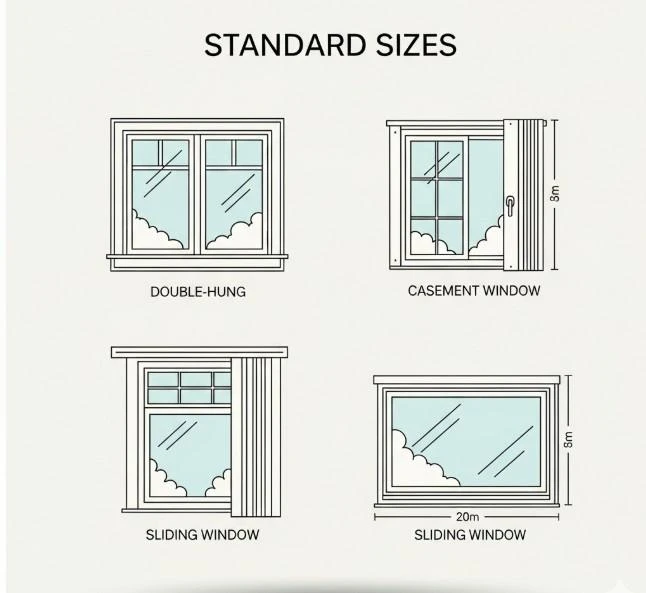
In addition to common window sizes, builders also divide windows into style groups—each with a standard width and height range. These are the most universal examples employed:
Double-Hung Windows
They have two sashes that open vertically, offering airflow from the top, bottom, or both. A popular choice in historic homes, they are flexible and effective.
Casement Windows
Side-hinged, casement windows are like a door. They are perfect for allowing breezes in and shutting tightly for energy efficiency.
Sliding Windows
Sometimes called gliders, they slide open horizontally on a track. Sliding window sizes are perfectly suited to wide walls where vertical height space might be limited.
Prior to buying or replacing windows, one should know how sizing is represented. In the United States, window measurements use a width × height system in inches. In new construction, contractors typically take "rough opening" measurements—the framed space before trim and insulation. In replacements, homeowners need to take three readings across both height and width of the interior of the old frame, using the lowest readings. This gives a snug fit and prevents costly gaps.
In real life, contractors use typical house window dimensions, such as the most common ranges for various rooms. Bedrooms typically get double-hung windows around 24–36 inches wide, for example, while super-large living rooms can utilize huge picture windows to gain the most benefit from sunlight.
To facilitate easier selection, the following window size chart indicates the most typical sizes for the most popular models. These sizes reflect availability from most major manufacturers and are particularly useful when comparing double-hung window sizes to sliding or fixed window sizes.
|
Window Type |
Width Range (inches) |
Height Range (inches) |
|
Double-Hung |
24, 28, 32, 36 |
36, 48, 54, 60, 72 |
|
Casement |
17, 23, 29, 35 |
41, 53, 65, 77 |
|
Sliding |
36, 48, 60, 72 |
24, 36, 48, 60 |
|
Picture/Fixed |
24–96 |
12–96 |
|
Bay Windows |
42–144 |
36–84 |
|
Bow Windows |
60–192 |
36–84 |
This chart is an easy reference guide for homeowners and professionals alike to depend on, instilling confidence when selecting or negotiating windows with wholesalers.
In contrast to a normal rectangular design, bay and bow window sizes vary significantly due to their three-dimensional nature. Bay windows typically consist of three panels projecting out from the wall to form an inviting alcove. Bow windows, however, use four or more panels bent into a smooth arc.
For bay windows, standard bay window dimensions are 42–144 wide and 36–84 tall. Bow windows are even larger, customarily measuring 60–192 wide. Due to the large effect such windows have on both the inside and outside of a home, custom installations are usual.
Homeowners prefer to use bay and bow windows designs to enhance curb appeal, expand inside space, or create reading areas. Even though manufacturers provide broad guidelines, most prefer to modify dimensions to suit unique architectural designs and personal tastes.
Because there are so many options, how do you select the right size? Start by thinking about your house's design, what each room will be used for, and in what way it is oriented to natural light.
For example:
Bedrooms can benefit well from double-hung windows for air and privacy.
Living rooms often have big picture windows to look out.
Kitchens often use casements over sinks to provide better access.
Energy efficiency must also guide your choice. Larger panes may require double or triple glazing to maintain insulation. At the same time, oversized bespoke windows can be extremely costly.
Getting the balance right between form and function is necessary. In most cases, the application of residential standard window sizes allows for easier installation, lower cost, and faster availability. However, for statement design features, homeowners can utilize non-standard openings.
When placing replacement orders, check both the common window size and the manufacturer's size chart. Double-check measurements with a professional installer before ordering.
Window size is crucial for homeowners, architects, and contractors. Correct knowledge saves time, avoids costly mistakes, and allows for a superior result in both performance and appearance.
Standard window sizes are offered for the most popular types of windows, which makes installation and replacement simpler.
Having knowledge of bay and bow window sizes and versatility allows house owners to come up with magnificent architectural enhancements.
A reliable window size chart allows comparisons between dimensions for different styles, from double-hung window sizes to sliders, casements, and picture windows.
Using standard sizes (where possible) saves money while ensuring compatibility with frames and wall structures.
Whether building a new house or renovating an existing one, knowing sizing is the secret to a successful project. By planning accurately and consulting the charts, homeowners can select windows that enhance design, comfort, and efficiency for years to come.

Free online quote in minutes — or talk to a project manager today.