Wednesday, 26 February 2025 11:16:00 Author Andrii Chernitskiy
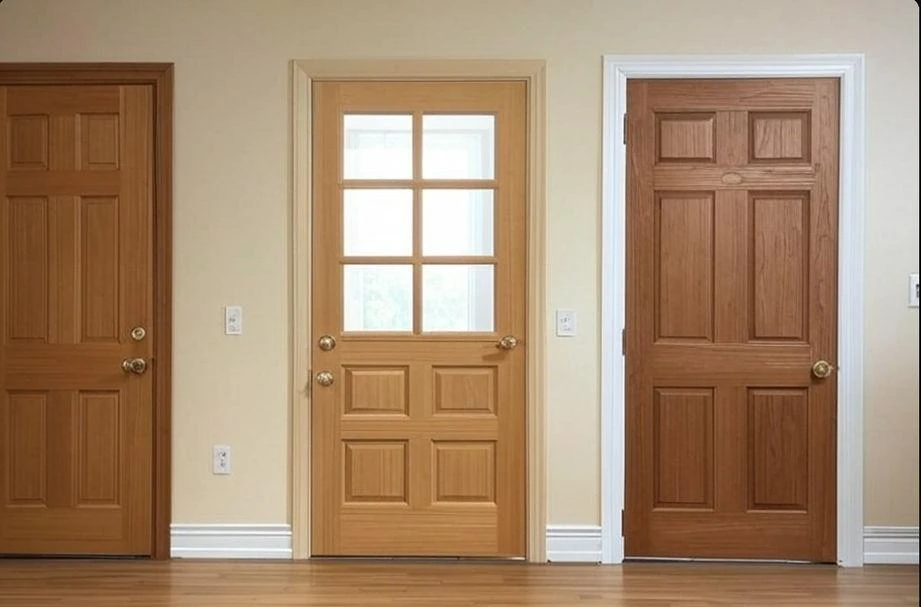
The standard door size in the US for exterior entry doors is 80" x 36" x 1 3/4". The interior doors have an 80-inch height but use a thickness of 1 3/8 inches. Using a standard size ensures easier installation and minimal modifications.
The standard door size for residential homes is 80" x 36". Interior doors may vary in width depending on the room sizes. Builders use this size since it fits well in frame design, hardware designs, and accessibility needs.
Exterior doors typically use a thicker 1 3/4-inch slab, while interior doors use 1 3/8-inch slabs.
Contractor tip: Before ordering a replacement door, measure the actual opening rather than the old slab. Settling can leave a frame slightly out of square even when the existing door appears to fit correctly.
Most bedroom and living area doors range from 30" to 36" wide, with 32" and 36" being the most common choices in modern homes. Hollow-core doors usually weigh around 15-20 lbs, while solid-core models weigh approximately 40-60 lbs and provide noticeably better sound control between rooms.
Bathroom and closet doors are commonly 24"-28" wide and still maintain the standard 80-inch height. Most residential locksets use a hardware backset of 2 3/8" or 2 3/4", making replacement hardware easy to source.
Standard bifold closet doors are available in 24", 30", 36", 48", 60", and 72" widths. These sizes cover most residential closet openings without requiring custom framing.
The standard front entry door measures 36" x 80", although taller 96-inch entry systems are increasingly popular in custom homes. Double-entry configurations are commonly available in combined widths of 60", 64", and 72".
Homeowners comparing replacement options can explore the entry door collection before finalizing measurements.
Most patio sliders are manufactured in standard widths of 60", 72", 96", and 144". These dimensions allow larger glass areas while keeping installation straightforward.
See patio and sliding door sizing options for common configurations and opening requirements.
Garage man doors and side-entry doors are typically 32"-36" wide and follow the same 80-inch height standard used throughout residential construction. Insulated steel doors generally achieve an R-value of approximately 5-6, compared to roughly R-2 for many solid wood doors.
| Door Type | Door Size (W x H) | Rough Opening (W x H) | Header Height |
|---|---|---|---|
| Standard Interior | 32" x 80" | 34" x 82.5" | 82.5" |
| Standard Exterior | 36" x 80" | 38" x 82.5" | 82.5" |
| Double Front Entry | 72" x 80" | 74" x 82.5" | 82.5" |
| Bifold Closet (2-panel) | 48" x 80" | 49" x 81" | 81" |
| Patio Slider (2-panel) | 72" x 80" | 73" x 81.5" | 81.5" |
For most residential projects, calculate the rough opening by adding 2 inches to the door width and 2.5 inches to the door height. The standard header height for an 80-inch door is typically 82.5 inches (6'-10.5").
An 80-inch door remains the industry standard and works in most homes.
An 84-inch door will enhance the overall height of a renovated space without altering any structure. The use of a 96-inch door makes the space look more elegant but may require higher header frames and material.
Notes from an installer: Though higher doors may appear appealing, ensure that you measure your ceiling height and header frame location before purchasing.
The ADA requires at least a 32-inch-wide door clear opening and does not exceed 0.5 inches in threshold height.
Adequate maneuvering clearance must also be maintained on the pull and push sides of the door.
Where fire separation is required, doors may carry ratings of 20, 45, 60, or 90 minutes. In those situations, consider fire-rated steel entry doors that meet applicable code requirements.
Canadian installers often allow larger expansion gaps because freeze-thaw cycles and seasonal humidity swings place additional stress on frames. While a typical US installation uses about a 1/2-inch shim gap, many contractors in Canadian Zones 6-7 leave an additional 3/16"-1/4" of expansion allowance.
| Climate Zone | Recommended Approach |
|---|---|
| Zone 4 | Standard framing tolerances are usually sufficient |
| Zone 6-7 | Increase expansion allowance by 3/16"-1/4" to reduce seasonal binding |
Contractor tip: Most winter door service calls are caused by frame movement rather than defective hardware.
Standard doors are almost always less expensive and easier to source than custom units.
Many stock-size doors can be obtained instantly, whereas custom doors may take several weeks for manufacture and delivery. In cases where the doorway is not an unusual size, stock sizes are always the better deal.
Review the structure and parts of an exterior door if you need help identifying components during measurement.
Most mobile home exterior doors are 32 inches wide and 76-80 inches tall, depending on the manufacturer.
No. The rough opening must always be larger than the door, not smaller.
Most residential French door systems use two 30", 32", or 36" panels for combined widths of 60", 64", or 72".
For related planning information, see the standard window size guide when coordinating door and window dimensions throughout a renovation project.

Free online quote in minutes — or talk to a project manager today.